USA
USA


The Gaggia Classic GT Dual-Boiler Review

Gaggia is a legendary company within the world of espresso. Achille Gaggia’s historic Lampo system for espresso extraction changed the world of coffee forever and is responsible for the crema that floats at the top of each cup. In modern times, Gaggia is well known for their array of 100% Italian super-automatic espresso machines, and even more so for the iconic Gaggia Classic, a machine long hailed as the best value entry level espresso machine ever made. But, in 2025 Gaggia crossed a new threshold, setting foot into the world of prosumer espresso machines for the very first time. Ladies and gentlemen, that Gaggia Classic GT has arrived.

$1,529.00
Build Quality and Design

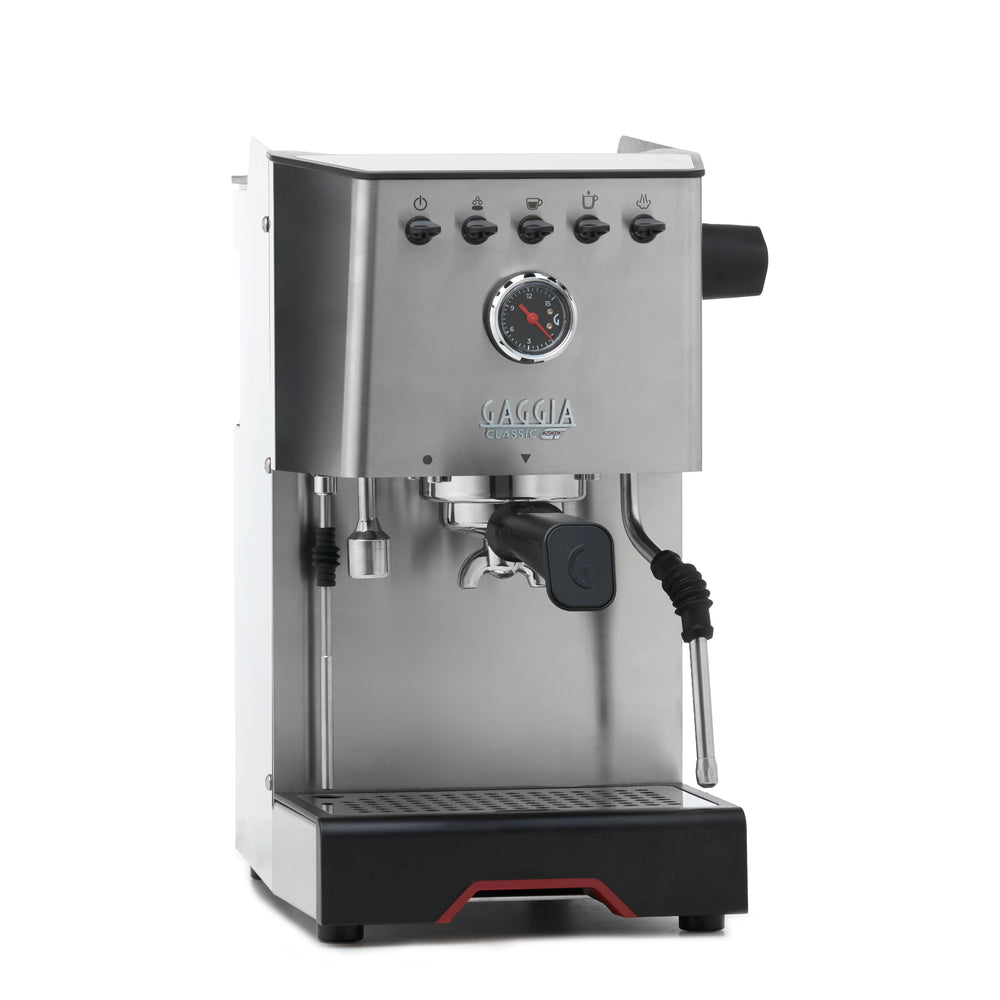
At first glance the Gaggia Classic GT’s design lineage is immediately discernable. It maintains a semblance of the traditional Classic aesthetic with similar lines and workflow orientation. Sizewise, it's considerably larger at nearly 16.5” deep and 16.7” tall. The increased space is to accommodate the Classic GT’s key change from the original, a second boiler for steaming and hot water tucked further back in the machine. The brew boiler remains in the same position above the brew group, leaving the overall look of the Classic GT unchanged from the original design. Internally the Gaggia Classic GT uses dual PID regulation of both boilers and the brew temperature and steam temperature can be set and maintained independently.

Where things begin to differ is the inclusion of a dedicated brew pressure gauge and a suite of five toggle switches on the front panel of the machine and a capacitive touch interface directly above them. The toggle switches are a departure from the rocker switches found on the original Classic. In terms of body construction and housing the GT is primarily a two piece machine with a massive brushed stainless steel body panel that wraps around the majority of the components with a second smaller piece of steel that encloses the brew boiler. At the base of the machine are a set of four small feet to prevent slipping and a stainless steel cup warmer tray located behind the capacitive touch interface.
One thing that hasn’t changed is that each switch also has its own dedicated LED ring that illuminates to communicate the status of each particular function. The five switches from left to right are:
- Power: This switch turns the machine on and off and the LED around the switch illuminates when the machine is powered on. There is also a hard power switch in the back of the machine that must be flipped into the on position as well.
- Pre-Infusion: This switch has two functions. It can be pressed and held to manually pre-infuse coffee. Tapping the switch toggles the automatic pre-infusion function on and off with the LED illuminated when automatic pre-infusion is active.
- Brew: This switch begins brewing. Pressing and holding will enter volumetric programming mode. The LED will flash when the machine is still heating to your programmed brew temperature and remain solid once that temperature is reached.
- Hot Water: This switch dispenses hot water. The LED around the switch will only illuminate when the machine is set to its dedicated hot water mode (more on that in a bit).
- Steam: This switch toggles whether the machine is in steam mode or hot water mode. When in steam mode, the LED will flash while the boiler is heating to your desired temperature and stay solid when that temperature is reached.

On the top of the machine, the capacitive touch interface is easy to navigate with four dedicated buttons for navigation. In its default state, the display will show you your currently selected brew and steam temperatures with icons on the right margin of the screen displaying whether or not a particular boiler is active. When the machine is heating, the current brew temperature will be displayed above your programmed temperature for real time temperature feedback. Brew temperature can be adjusted in 1° increments simply by pressing the “-” and “+” buttons. The leftmost button accesses the GT’s programming menu at which point the “-” and “+” buttons now allow you to scroll left or right through the menu options with the final “✓” button used to confirm selections. The following settings can be adjusted from within the menu:
- Automatic Pre-Infusion: This allows you to select one of three pre-programmed automatic pre-infusion cycles (I cover this in greater detail later on in the article)
- Wake-up Timer: This allows you to schedule the machine to power on automatically at a specific time of day.
- Stand-by: This allows you to program the machine to turn off automatically after a set period of inactivity.
- Ecomode: This mode is used to switch the steam boiler from steam to hot water mode after a set amount of time has elapsed in order to save power. You can still dispense hot water but will need to press the steam switch to heat the steam boiler back to your desired temperature.
- Button Sound: This enables or disables the beeping sound the buttons make when pressing them.
- Temperature Units: This allows you to change the temperature displayed between either Celsius or Fahrenheit.
- Steam Temperature: This allows you to set the steam boiler to one of four predetermined temperatures.
Overall as someone who is very familiar with Gaggia’s super-automatic espresso machines, the interface on the GT is highly reminiscent of them and is quite intuitive to use compared to the typically much more claustrophobic interfaces found on most prosumers.
Shared Components

On the topic of build quality, most people would be inclined to think about the Classic GT relative to the Classic E24, but that’s not a particularly useful comparison. The truth is that Gaggia followed the same paradigm as companies like Profitec and Rancilio. The Profitec MOVE uses the same group and brew boiler as the Profitec GO and the Silvia Pro X uses a modified version of the standard Silvia Group and brew boiler. This same design philosophy is present on the Classic GT with the Classic E24's lead-free brass boiler serving strictly as the GT's dedicated brew boiler.
In an apples to apples comparison with the E24, the boiler in the GT is slightly modified. Compared to the original boiler, the GT's has been tapped on the top with a copper capillary tube that connects to a brew pressure gauge and outfitted with a temperature probe to communicate brew water with the PID. Apart from also sharing the same vibration pump, the major shared parts end there.
Classic Identity

Despite actually sharing very few 1 to 1 parts with the Gaggia Classic E24, the Classic GT still inherits several design elements that are inherently part of the “Classic” identity.
For starters, despite having a newly designed portafilter, the Classic GT’s group still accepts and is compatible with any portafilter that fits the original Gaggia Classic. This is also the case for the shower screen, though not the shower holding plate.

As an update to the ring group design that sees the brew boiler located directly above the brew group, the shower holding plate has been updated so that when removed, it will cause the contents of the boiler to drain. This is especially useful when putting the machine into storage or transporting it over long distances, but comes at the cost of making the brew group incompatible with existing shower holding plates as a small o-ring has been used to create a seal between the holding plate and the group.

Something else you might have noticed is that the orientation of the steam valve and steam wand remain unchanged from the original Classic, with both being located on the right side of the machine. This breaks the typical prosumer convention of putting them on the left. As a right handed person myself, my preference when steaming is always to hold the pitcher in my left hand and operate the valve with my right. On the GT, the distance between the brew switch and the steam knob is very small and stopping brewing involves simply tapping the brew switch or allowing it to stop automatically.
In addition to the steam valve and wand position, the Classic GT also retains the external duct that discharges wastewater from the 3-way solenoid valve into the drip tray. The key difference now is that the drip tray on the Classic GT can actually be raised up in order to change the distance between your portafilter and your cup. In its default configuration the GT offers an impressive 4.5” of cup clearance. With the drip tray in the raised position, clearance is reduced to 2.7”.

To accommodate the variable position tray, the decompression duct is now telescopic and can be shortened or lengthened as needed based on your machine’s current configuration. This design choice honestly reminds me of the variable height trays and cup risers from Gaggia Cadorna and Magenta series machines and is a nice infusion of pragmatic super-automatic design philosophy into a prosumer machine.
Standout Components
Many components of the Classic GT were built for it specifically. Two key examples both happen to be valves, the steam valve and OPV in particular.
The Steam Valve

The Classic GT’s steam valve is a significant departure from the one that’s been used on Classic family machines for the last several decades. Custom designed for the GT, the valve is made from beautiful lead-free brass with the iconic Gaggia “G” milled into the design. The valve is significantly more durable than that of the original Classic and features a fully articulated ball joint that permits the steam wand to move freely in all directions.
The OPV

It’s no secret that people have been particularly interested in the OPV in the Gaggia Classic for some time; so much so that we worked with Gaggia to offer a custom version of the Classic E24 that features a 9 bar OPV. With the Classic GT, Gaggia took the same route as with their steam valve and had a custom brass OPV designed for the machine. The valve is externally accessible from the bottom right side of the machine and can be adjusted with a flathead screwdriver.

Not only is the valve easy to access, but it also features a very wide range of brew pressure ranging from 3 to 15 bar. A -/+ symbol on either side of the valve access shows you which direction increases or decreases pressure with one half turn of the valve resulting in a change of 1 bar of pressure.
Dual Pumps

Obviously the Classic GT has two boilers, but did you know that it also has two pumps? This uncommon feature is something that primarily benefits milk drink lovers because both boilers have their own dedicated pumps. On single pump heat exchanger and dual boiler machines, the fill level probe in the boiler can trip in the middle of extractions, especially if you’re steaming milk at the same time. Because the GT has a second pump dedicated entirely to filling the steam boiler, your extractions will never be interrupted or lose pressure as a result of the steam boiler running low.
Brewing

Brewing with the Classic GT is a joy. This will be the only time I say it, but Gaggia really seems to have thought of everything with this machine. There are several ways the GT can accomplish its core function of brewing espresso with varying degrees of sophistication and user involvement. At its most basic, the GT brews espresso using a 0.12L / 4oz lead-free brass brew boiler and a vibration pump with a stock flow rate of about 7g per second. That’s really just the tip of the iceberg however as the GT offers not one, but two dedicated pre-infusion functions, one automated and the other fully manual and the ability to program extractions volumetrically.
At the heart of the Classic GT is the same brew boiler found inside the Classic E24 alongside the same vibration pump. Where things differ on the Classic GT is the inclusion of a PID controller that regulates the temperature inside the boiler that can be modified in 1° increments. The vibration pump has also been granted an exceptional upgrade to its performance thanks to the GT’s custom control board which allows it to operate at a reduced 3g/sec flow rate when one of the GT’s pre-infusion modes is being utilized.

In terms of brewing performance the boiler heats incredibly fast at just six minutes and is incredibly temperature stable with the ability to pull back to back shots at or within <2° of 200° without the need for cooling flushes or extended wait times for recovery.
Variable Pre-Infusion

Pre-infusion has been implemented on non-E61 group machines in a number of ways, but the Classic GT was designed with a dedicated feature that was included for low flow introduction of water to presaturate the coffee puck. The pump produces a low flow of water at approximately 3g/sec during the pre-infusion mode and brews at approximately 7g/sec during regular extraction. Depending on your preference the Classic GT allows you manually pre-infuse for up to 30 seconds
Pre-Infusion Presets

The Gaggia Classic GT is equipped with three automatic pre-infusion presets that can be selected via the programming menu and toggled using the pre-infusion switch on the front of the machine. When automatic pre-infusion is active, the LED ring surrounding the pre-infusion switch will be illuminated and the GT will execute your selected cycle prior to brewing. The automatic cycle can be cut short at any time simply by pressing the pre-infusion switch which causes the machine to proceed to full extraction flow.
The three cycles are intended for Dark, Medium, and Light roasted coffees with unique low flow and soak times that I’ve listed for you below.
- Dark: 2 sec low flow / 1 sec soak
- Medium: 8 sec low flow / 3 sec soak
- Light: 12 sec low flow / 3 sec soak
Manual Pre-Infusion

The crown jewel of the Claggic GT’s brewing capabilities is its fully manual, low flow pre-infusion. To manually pre-infuse coffee simply press and hold the pre-infusion switch. The pump will engage in low flow mode for as long as the switch is held and the screen will be divided into three segments to display your active low-flow pre-infusion time, your soak time, and your full flow extraction time. Releasing the switch will
Volumetric Programming
In addition to its pre-infusion capabilities you can also program extractions volumetrically via the brew switch in order to have the Classic GT stop brewing automatically once your desired in-cup dose (volume) has been reached. This is done by pressing and holding the brew switch until the word "Preset" appears on the display. When you end your shot, the final volume registered by the flow meter will be saved and dispensed the next time you prepare a shot with a volume preset enabled. The word "Preset" will remain on the display to let you know that you're in volumetric mode. To switch back to regular brewing, simply press and hold the pre-infusion and brew switches until "Preset" disappears from the display (pressing and holding them again will re-enter volumetric mode).

Because the volumetric function is programmed via the internal flow meter inside of the Classic GT, it’s important to use actual in-cup measurements taken by a scale with a prepared shot of espresso in order to achieve consistency with your results. The shot time displayed on screen during and after brewing may vary despite the same amount of water being dispensed. Changes in temperature, ground coffee dose and grind size can affect the rate at which water flows through your puck so you’ll still want to be consistent and meticulous when it comes to puck prep if you want to make proper use of this feature.
Using Volumetric with Pre-Infusion
Volumetric brewing can also be used in tandem with the built-in pre-infusion presets though you'll want to follow some guidelines in order to achieve best results. The volumetric programming doesn't account for added water from pre-infusion, so if this winds up throwing your dosing off with extra liquid, you can try our suggestions below when programming in tandem automatic pre-infusion to see if you can get more accurate results. Simply stop your shot short based on our suggested offsets to account for water added during pre-infusion.
- Dark: -2g Offset
- Medium: -6g Offset
- Light: -18g Offset
Steaming and Hot Water

As a dual boiler machine the Classic GT can brew and steam simultaneously as you might expect. However, compared to other dual boiler machines with PID controllers the Classic GT does a few things a little differently. While the brew boiler can be programmed in 1° increments, the steam boiler can be set to one of four preset temperatures via a dedicated menu. There is also a lower temperature hot water mode that can be toggled as an alternative to steam mode.
Steaming

Steaming with the GT is an experience on par with most prosumer espresso machines. Like I mentioned, the boiler can be set to one of four temperatures, 248°, 257°, 266°, 275° though based on my personal preferences I would only ever use 266° or 275°. When we tested steaming on the Classic GT we used the 275° setting and we were able to steam 5oz of refrigerator temperature milk to 140° in just 20 seconds. The steam wand is fully articulated so it's easy to find a good angle for steaming and the wand has a single hole tip so I find that tilting the frothing pitcher helps to encourage a roll in order to incorporate air for micro foam.

This isn't the fastest steaming performance I've ever seen on a home prosumer machine, but it's still very adequate and there's also the matter of recovery time. That is to say that the Classic GT actually doesn't require any recovery time between steaming. The single hole and efficient heating element produce a balanced output that basically allows the machine to steam indefinitely. Coupled with the second pump that supplies the boiler directly, you can steam all day on the Classic GT and never disrupt your espresso brewing.
Hot Water

The Gaggia Classic GT is capable of producing hot water on-demand via a line tapped to the steam boiler. Similar to the Rancilio Silvia Pro X, hot water dispensing is controlled via a switch that opens a dedicated solenoid valve located between the boiler and the water spout. Unlike the Silvia Pro X which will only dispense when a particular boiler pressure has been reached, the Classic GT can continually dispense hot water as often as you press the hot water switch. This means you can dispense water earlier or top off a particularly tall Americano even if the steam boiler hasn't reached its set temperature.

Something that sets the GT apart in the hot water department is the fact that it actually has a dedicated hot water mode that can be toggled via the steam switch. When pressed, the LED around the steam switch will power down and the LED for the hot water switch will illuminate to indicate that the machine is now heating for hot water. The temperature is lowered so that it still produces enough heat and pressure to dispense hot water, but not quite enough for steaming. The resulting water is dispensed much more gently, without the billowing steam and sputtering water common to most hot water wands on heat exchanger and dual boiler espresso machines. As someone who makes frequent use of hot water for Americanos, Gaggia’s attention to detail with this feature was something that I really appreciated when getting to know the GT.
Final Thoughts

The Gaggia Classic GT is a serious piece of equipment, vastly outperforming not only the original Gaggia Classic but also a wide range of prosumer espresso machines from a number of manufacturers. For their first prosumer, Gaggia has made a machine that is flexible enough to satisfy any user. Rock solid brew temperatures and a slew of pre-infusion features make this the perfect choice for anyone looking to experiment with specialty grade coffees. At the same time, the near endless steam pressure, dual pumps, and volumetric brewing allow it to pull double duty for daily milk drinks and entertaining.
The original Gaggia Classic has endured because it offers consistently excellent value for the money. I have little doubt that in the world of prosumer espresso machines, the Classic GT will come to be viewed in much the same way.
Things we Love
- Variable Low-Flow Pre-infusion
- Rapid Heat-Up Time
- Dedicated Hot Water Mode
- Made in Italy
- Compatible with Existing Classic Portafilters
Things to Consider
- Reservoir Only
- 4 Steam Temperature Settings
Photography and Graphics by Grace Walker and Elley Ellison
Shop This Blog
-
 With super-precise PID-regulated brew temperatures, 3g-second low-flow manual and automated pre-infusion, time-of-day programming, and more, the Gaggia Classic GT is a best value dual boiler espresso machine that can handle any type of coffee and produce near unlimited steam when frothing milk.
 -
 The Gaggia MDF 55 is an easy-to-use all-purpose grinder with 55mm hardened steel flat burrs and one of the quietest motors available. With built-in anti-static technology, the MDF 55 delivers consistently fluffy and clump-free grounds in one of two easy-to-set timed doses.
 -
 Hand-crafted from brushed or powder-coated steel and gorgeous, sustainably-harvested wood, the Adjustable Tamp Station from Wiedemann Manufaktur doesn’t just improve your puck prep process—it takes the look of your espresso setup to the next level.
 -
 The Gaggia Tamping Mat is perfect for securing your portafilter while tamping to ensure consistent puck preparation while protecting your counter.
 -
 Your Mignon, elevated. This gorgeous glass hopper holds up to 550 g of whole-bean coffee and helps keep it fresh with a rubber sealing metal lid. It’s easier to clean and much easier on the eyes than standard plastic hoppers.
 -
 Wiedemann's WDT Stand is the perfect tool to protect the needles of your WDT tool by elevating them off of the counter while matching your other Wiedemann accessories.
 -
 The Wiedemann WDT Tool is an essential accessory for espresso puck prep to produce fluffy and well distributed grinds. Its premium walnut construction and interchangeable needles are designed to last.
 -
 The AKU scale from Varia is a compact and precise coffee and espresso scale with a waterproof design and 0.1 gram accuracy. Its aluminum housing imparts a premium tactile feel not found in competing scales at this price.
 -
 Varia's Dosing Cup is a premium dosing cup made from space-grade aluminum alloy. It features a removable ring that can double as a dosing funnel and a magnetic base that locks in on the Varia VS3 grinder.
 -
 Hand-crafted from brushed or powder-coated steel and gorgeous, sustainably-harvested wood, the Tamper Station V2 from Wiedemann Manufaktur doesn’t just improve your puck prep process—it takes the look of your espresso setup to the next level.


Related Articles

Profitec MOVE Espresso Machine Review

Gaggia Classic Pro E24 Review