USA
USA


Comparing Pre-Infusion on Home Espresso Machines

If you own an espresso machine or you’ve been doing research to purchase one then I’m sure you’ve encountered the term “pre-infusion.” Put simply, pre-infusion refers to the introduction of water to the coffee grounds in the portafilter before the infusion phase begins, sometimes called "pre-wetting." Some machines do this at a lower pressure and/or flowrate, while others very briefly engage the pump fully. Either way, it's often followed by a pause to allow to the water to soak into the puck. The objective and benefit of doing this is to mitigate channeling during the extraction phase. Channeling is when water finds the path of least resistance in the puck through cracks or other inconsistencies, leading to an uneven extraction. If you own a bottomless portafilter, you may have seen how this produces erratic streams.

Not too long ago, the options for machines with the ability to pre-infuse were very limited and a lot of attention was paid to controlling pressure. As the market has matured and manufacturers have become more in sync with home espresso, there has been an explosion of new options and solutions to enable lower water flow prior to extraction. This has also allowed for greater experimentation with brighter, lighter roasted coffees since pre-infusion can be used to reduce acidity.
These days it does seem like most machines offer some kind of low-flow functionality, but it does raise the question, “is all pre-infusion equal?” And that’s what we’ll be taking a look at in this article. I’ll be going over some of the various ways that manufacturers have implemented pre-infusion on modern machines and getting into more detail about what it really means in raw numbers. We couldn't cover everything, but I've got some pretty popular machines for you to check out in the table of contents if you feel like skipping ahead.
What is Pre-Infusion?
When it comes to pre-infusion, I sometimes hear people use the same term for two different things. Before I really get going with this article, I want to define some terms I’ll be using, in my own words. If you’re already familiar with these terms, feel free to use the contents bar on the left side of the screen to skip to the action.

This is a good time to clear this one up too: Pre-infusion is NOT the time before you see the first drop of espresso come out of the portafilter. A delay between the time you started the shot and seeing the first drops is normal and expected, even when pulling a shot with no pre-infusion phase.
Active Pre-Infusion
Active pre-infusion is a type of pre-infusion where water is dispensed with the pump fully operating, just like it does during infusion. There should always be some kind of a pause after an active pre-infusion, whether it’s soak time or passive pre-infusion. Without that pause, you basically don’t have a pre-infusion; you just have the main infusion/extraction phase.
Low-Flow Pre-Infusion
Low-Flow pre-infusion is a form of active pre-infusion. The main difference is that low-flow pre-infusion introduces water at a significantly lower flowrate either through modulating the pump output or mechanically restricting the flow of water. Other than that, it’s exactly what it sounds like – a lower flowrate of water is dispensed from the grouphead, yes, similar to the gentle flowrate provided by a passive pre-infusion. Speaking of passive pre-infusion...
Passive Pre-Infusion
Passive pre-infusion dispenses water by opening the solenoid valve, but the pump does not kick on. This results in a much gentler flow of water from the grouphead. Some espresso machines only have an option for passive pre-infusion, while others allow you to program an active pre-infusion time followed by a passive pre-infusion time in lieu of a soaking phase.

Soaking Phase
The soaking phase is the amount of time after pre-infusion, but before extraction. Little to no water is dispensed from the group during this phase. Instead, the coffee grounds are taking this time to soak up the water that has already been dispensed during pre-infusion.
Comparison by Brand
While the general concept behind pre-infusion remains the same across brands, how it’s accomplished can vary. I want to take some time to talk about how some of the most popular models and manufacturers have implemented pre-infusion and provide a closer look at actual numbers when it comes to things like flow rates and the total amount of water being dispensed.

For pre-infusion flowrate testing, I measured the amount of water (by weight) dispensed during the pre-infusion phase for each machine. I gathered 3 samples in a row for several seconds (up to 20 seconds where possible, or the maximum allowed), and then waited for the boiler to recover between each sample. The test results provided in the charts below are an average of 3 samples, shown in grams per second.
Gaggia Classic GT

The Gaggia Classic GT uses a unique method of varying the pulsing of the vibration pump in order to achieve a lower flow rate of roughly 3g/sec for pre-infusion. Based on your preferences, the GT can either use a pre-programmed pre-infusion followed by corresponding soak time, or you can manually control pre-infusion for up to 20 seconds of active flow and 15 seconds of soak time.

The pre-programmed pre-infusion options on the Gaggia Classic GT are labeled by roast level: Light, medium, and dark. If you choose DRK pre-infusion, you’ll get 2 seconds of low-flow, followed by 1 second of soak time. For MED pre-infusion, 8 seconds of low-flow hits the puck with an additional 3 seconds of soak time. For those light roasts that channel much easier, LGT pre-infusion gives you an entire 12 seconds of low-flow followed by, again, 3 seconds of soak time.

Since dark roasts are so soluble, they’re not quite as prone to channeling. Pre-wetting the top of the puck for only a couple seconds helps the water find its way to the bottom of puck evenly. Following that concept about solubility being related to your roast level, the medium pre-infusion utilizes much more time during low-flow. And finally, the light pre-infusion, being the longest, saturates an entire puck in our testing, greatly mitigating channeling.

I drink a lot of light and medium roasts, so I’ve been using those pre-infusion programs on the GT. But, I’ve also been enjoying using the manual mode for those times when I don’t want a program telling me how to brew.
Rancilio Silvia Pro X

The Silvia Pro X uses a feature called “Variable Soft Infusion” to gently introduce water from the boiler to the puck prior to extraction by opening the solenoid valve without running the pump. When enabled, infusion time can be set between 2 and 6 seconds after which the pump will engage and brewing will continue as normal. This results in approximately 2 grams per second, a very gentle pre-infusion. In the same way the Gaggia Classic GT uses only a bit of water for dark roast pre-infusion, I’d recommend this kind of pre-infusion with a dark roast here too.

Lelit Elizabeth

The Lelit Elizabeth uses a similar style of pre-infusion to the Silvia Pro X by opening the solenoid valve and allowing water to flow into the puck. The key difference being that upon starting your extraction, the pump will kick on for roughly a second and then stop. Then, with the solenoid valve still open, water will continue to gently flow from the group. The Elizabeth allows you to program between 1 and 20 seconds of pre-infusion and set unique times for both the single and double extraction buttons.

This was a very interesting pre-infusion test. The water flow during the passive phase of the Elizabeth’s pre-infusion is provided by pressure from the steam boiler. This results in a flowrate well above the stock flowrate, albeit without additional force from the pump. Of course, since this machine allows you to disable the steam boiler, I had to see what the flowrate would be with the steam boiler off. That flowrate was about half the stock flowrate. This makes sense since the steam boiler is much more pressurized than the brew boiler. I’ve got more exact numbers for you in the chart below.

E61 Groups and Flow Control Devices

If you’re unfamiliar with the E61 flow control device, it’s an optional valve that can be installed in espresso machines with E61 brew groups. The device works by allowing you to increase or restrict the amount of water that can flow through the group head. There are several different designs of this device from a number of manufacturers with varying ranges of motion that govern potential flow rates. It’s also important to note that based on the type of pump used in a machine as well as the manufacturer, stock flow rates will vary by model, so different machines can behave differently even if they both have flow control.


E61 Lever Halfway
Even without a flow control device, you can still partially raise the lever enough to allow pressure in the boiler to push water out of the group and into the portafilter. Eventually as pressure in the boiler decreases, the flow will stop, but you can still pre-infuse for several seconds prior to brewing, which is more than enough for some coffees.
This drains water from the group assembly, so when you lift the lever all the way, it takes a few seconds to fill the cavity again. Because of this, the stock flowrate will take a few seconds to kick in. But, you’ll still get a few drops during this time at a similar flowrate as your pre-infusion.

Line Pressure Pre-Infusion

Line pressure pre-infusion was once a much sought after feature that was limited to machines that could be connected directly to a home water line. In our catalog, these machines were exclusively E61 group prosumers with rotary pumps. By lifting the lever without engaging the pump, the valve in the group will open and allow water to flow. This allows the pressure from the water line to push water out of the boiler and into the group. Because water line pressure has to be significantly reduced for espresso machines (generally around 2 bar), the pressure and flow of water at the group are also reduced which creates ideal conditions for pre-infusion.

ECM and Profitec’s Vibration Pump Machines
On several of the ECM and Profitec espresso machines that use a PID switch to control temperature, there is an optional pre-infusion function that can be enabled or disabled. It works by briefly running the pump to dispense water into the portafilter, followed by a pause before returning to full extraction pressure.
This is the kind of pre-infusion that I would say is worth trying out, but might not work for every coffee. For what it’s worth, I’m an advocate for adding flow control to any E61 machine since then you’ll have as much control as you could want. But, for those rejecting my advice, there’s still a pre-infusion option to play with.

The Profitec Move utilizes an active pre-infusion for a set amount of time, followed by such a light passive pre-infusion that it basically functions as a soak phase. However, the available time range is highly customizable with up to 60 seconds available for active pre-infusion and up to 40 for the pause, or soak time.

The passive phase dispenses about 20 extra grams of water for a few seconds before the flow dries up. If your passive phase is set to 8 seconds for example, most of that time will have no additional water dispensing through the group. Since the stock flowrate is a bit high (I noted 10.63 grams per second), and the active pre-infusion runs at the stock flowrate, I recommend utilizing a longer passive/soak phase to give the grounds ample time to soak up a good amount of that water.

Final Thoughts
The machines outlined here are the tip of the iceberg. It’s worth looking into what your machine is capable of and experimenting a bit. If you’re in the market for a new espresso machine, pre-infusion is becoming an important consideration in the home espresso world. Pre-infusion gives you the ability to affect the extraction and thus flavor of your coffee in different ways, and there’s no shortage of recipes to play with.
Photography and Graphics by Grace Walker and Elley Ellison
-
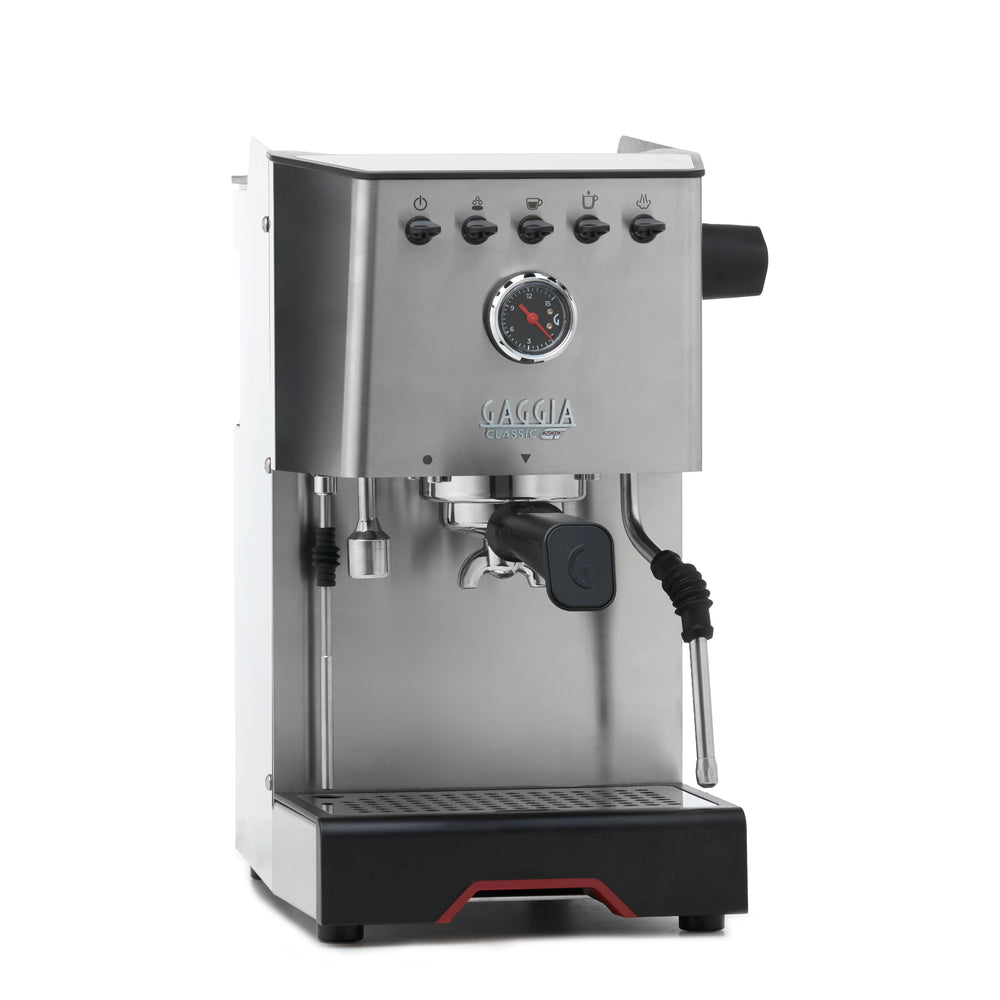 With super-precise PID-regulated brew temperatures, 3g-second low-flow manual and automated pre-infusion, time-of-day programming, and more, the Gaggia Classic GT is a best value dual boiler espresso machine that can handle any type of coffee and produce near unlimited steam when frothing milk.
 -
 The Rancilio Silvia Pro X is a dual boiler machine answering a combination of customer and community feedback centered around developing the original Silvia Pro to match espresso fanatics’ growing desire for experimentation when brewing.
 -
 The Lelit Elizabeth is an affordable and feature-full dual boiler espresso machine. Perfect for those who love espresso and specialty milk beverages equally, the Elizabeth threads the needle by offering on-demand steam and precise temperature control in equal measure.
 -
 The ECM Mechanika VI Slim is the latest iteration in ECM’s line of compact, luxury heat exchange espresso machines, and is now fitted with a three-position switch for added temperature stability and the ability to switch between preset temperatures.
 -
 The Profitec MOVE is an exceptional dual boiler espresso machine with a 9 minute heatup time. Stock with customizable walnut wood accents and a modular portafilter capable of both bottomless and spouted extractions, the MOVE is an incredible option for home baristas.
 -
 The Profitec JUMP is an attractive and easy-to-use heat-exchanger that features a 3-position switch to adjust boiler temperatures, automatic pre-infusion capabilities, and a simple OLED display that doubles as a shot timer during extractions. Profitec packed some serious power into this compact machine: despite being just 9” wide, the JUMP touts a 1.6 L boiler and a 2.8 L reservoir, so it’s fully capable of brewing multiple milk drinks in a row. With a brushed stainless steel housing and walnut accents, the JUMP evokes a simple and sophisticated aesthetic.
 -
 The Gaggia MDF 55 is an easy-to-use all-purpose grinder with 55mm hardened steel flat burrs and one of the quietest motors available. With built-in anti-static technology, the MDF 55 delivers consistently fluffy and clump-free grounds in one of two easy-to-set timed doses.
 -
 The AKU scale from Varia is a compact and precise coffee and espresso scale with a waterproof design and 0.1 gram accuracy. Its aluminum housing imparts a premium tactile feel not found in competing scales at this price.
 -
 With a pop of glossy color and an earthen terracotta body, the notNeutral series of cups and saucers is the perfect way to elevate your morning coffee experience, no matter what you like to drink.
 -
 Lelit’s Coffee Leveler is an essential tool for espresso prep. With an anti-slip handle for easy gripping, it smooths and polishes your bed of espresso to help ensure even tamping.


Related Articles

The Gaggia Classic GT Dual-Boiler Review

The Updated Wiedemann Flow Control Paddle